Digital Advertising Campaign Trends Across the Global Gaming Sector

The most popular category of digital advertising is gaming, which is the most rapidly evolving in terms of its playbook. Mobile games, console publishers and online casinos are competing over the same screen time, stealing each other formats in a few months, and playing by different rules on either side of the border. The campaigns that will be effective in 2026 bear little resemblance to those of five years prior and the differences tell a lot about where digital marketing as a whole is moving.
The clearest sign of the change is where a campaign now ends. For markets in New Zealand (NZ), the Spinyoo casino relies on a mobile casino setup where users click to get the Spin Yoo app via iOS or Android Download, using a single login to access both the app and the Spin Yoo online casino website seamlessly.
The Install Is the New Conversion
The store page was made the landing page once the install was the objective. Screenshots, preview videos and the first three lines of the description now bear the burden that a homepage hero used to bear, and the most rapidly expanding line of many gaming media plans is search inventory sold by the app stores themselves, where a bid on a competitor brand name reaches people at the point of decision.
The common currency is cost per install, which is a crude currency. An inexpensive install that does not open the app is worth nothing, and the more optimised campaigns now target an event further down the funnel, a first deposit or a third session, and a higher initial price to a user who sticks.
Store optimisation has become a science. Icon colour tests, screenshot sequence and the text of the subtitle are regularly tested to give conversion lifts that no media buy can achieve at the money, and that is why the store page is now briefed with the campaign, not after it.
Playable Ads and Try-Before-You-Download
The interactive ad began in mobile gaming, where a fifteen-second slice of a puzzle game proved to be much more effective than a trailer. The format has since been replicated throughout the industry, with slot studios providing advertising networks with a pared-down HTML5 version of a game that is loaded within another application, provides a few demonstration spins and terminates on the store button.
Marketers are two-fold in their appeal. An already played demo installs intentionally, reducing churn, and the demo also serves as a testing ground, as the version of a mechanic that captures attention in an advertisement is often the version that should start the tutorial within the game itself.
In the case of casino brands the format has a compliance wrinkle. A demo that awards imaginary credits may resemble an inducement in more stringent markets, thus most operators limit the number of spins, store winnings in no currency and locate the age line within the playable itself, not in the frame around it.
Creators, Streamers and the Shift From Reach to Trust
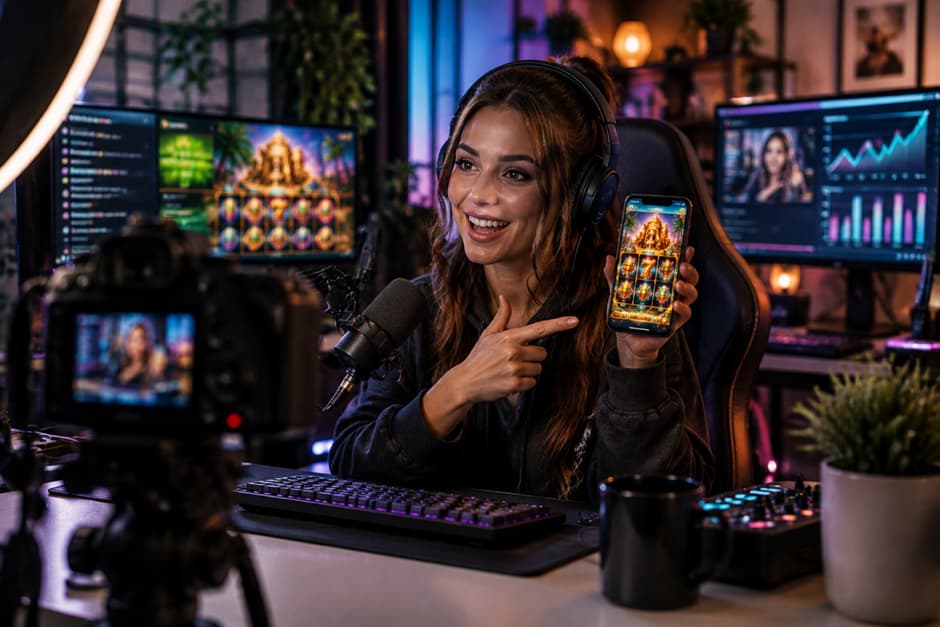
The most unstable channel in the sector has been streaming. In 2022, Twitch blocked streams of unlicensed gambling casinos, eliminating a significant portion of casino traffic in one night, and the money shifted to licensed casinos, to YouTube and to smaller platforms, and disclosure policies were added that had not been strictly enforced previously.
The larger movement is out of reach and into trust. Mid-sized creators with a dedicated fanbase are now out-performing celebrities on cost per install in most of the gaming industry, and an increasing portion of paid creative is designed to appear as creator content in the first place, shot on a phone and voiced by someone who clearly plays the game.
Regulators are putting more blame on the brand, rather than the creator, of an undisclosed deal. That has taken contracts and briefing decks through the type of compliance review that was previously the domain of television, and the days of a code word being slipped into a stream without a label are mostly behind us.
One Campaign, Many Rulebooks
There is no other type of advertising that has to rewrite itself so frequently at the border. In 2023, the Netherlands banned untargeted gambling advertising, followed by a near-total ban in Belgium, and an outright ban in Italy since 2019, with some markets that still allow it requiring a licence number, an age line and a responsible-gambling message on all assets. A global campaign is thus a template that has a legal layer that varies in each country.
The United Kingdom shows how far a single campaign has to bend. Since the 2022 rule change, creative there cannot carry strong appeal to under-18s, so the RegalRush casino promotes the RegalRush casino app with plain product shots of the mobile casino interface rather than the cartoon mascots that still run in other markets. The GB store listing leads with the iOS build, mirrors it for Android, and its Download page and login screen both repeat the age warning that the Regal Rush online casino website carries, since an app listing is treated as marketing in its own right.
Measurement After the Cookie
Measurement has changed as much as creative. Apple’s App Tracking Transparency framework requires an app to request permission before it shares user data with other companies for tracking across apps and websites, and most people, when asked, say no. Gaming marketers have answered with aggregated attribution, first-party data from their own lobbies, and incrementality tests that compare regions with and without a campaign instead of following individuals.
Android is following suit with its Privacy Sandbox, and the attribution information that still makes it to marketers is delayed, aggregated and depersonalized. An industry that has spent ten years perfecting per-user has been forced to re-learn media mix modelling and geo-testing, techniques that television buyers never forgot, and models that previously ran quarterly now update weekly.
What Marketers Should Watch Next

The next two years will be influenced by three developments. Generative tools are already generating hundreds of creative variations on a single short prompt, television has opened a screen that gaming brands have been largely ignoring, and regulators in the biggest markets are shifting their focus on rules about content to rules about targeting and frequency.
The red line through it all is that gaming has turned into the guinea pig of privacy-first marketing. Whatever measurement and creative disciplines remain alive in the industry amidst the combination of regulatory pressure and platform transformation will be the ones that all other categories will follow a year or two later.